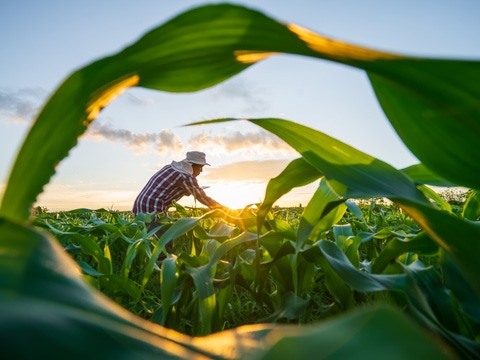
Farmers use tablets to analyse data and experiment with growing corn

Agriculture

Our Approach to Sustainability in Agriculture

Agriculture is shaped by interconnected environmental, economic, and social challenges. Farmers need to maintain productivity, crop quality, and their livelihoods while adapting to a changing climate, managing pressure on natural resources, and meeting the needs of the people and communities connected with agricultural production.

Addressing these challenges requires agronomic expertise, science, data, and innovation. At BASF Agricultural Solutions, we bring these capabilities together to evaluate where individual products and practices can contribute and translate the resulting insights into practical solutions for farmers and value-chain partners.

Member of the Board of Executive Directors, BASF SE, responsible for the Agricultural Solutions division.
The choices we make today will shape the future of agriculture. Our ambition is to create long-term value by advancing agriculture in a way that considers economic, environmental, and social priorities together.

Livio Tedeschi

Head of the BASF Agricultural Solutions Management Board

Our focus areas

Our sustainability approach is structured around three focus areas that reflect key environmental and social topics in agriculture:
Greenhouse gas (GHG) emissions from farming
Understanding and addressing GHG emissions associated with agricultural production, while considering productivity, crop quality and farmer livelihoods.
Soil health, water and biodiversity  
Developing and evaluating solutions and practices in relation to the natural resources on which agriculture depends.
Product stewardship and social responsibility
Supporting the safe use of agricultural products through stewardship, training and guidance, alongside initiatives addressing public health and societal needs.

Explore our focus areas in detail

Learn more about our focus areas and how they contribute to more sustainable agriculture:
Person using a measuring stick to take field measurements among tall green crops during agricultural field research.

1. GHG emissions from farming 

Through our Global Carbon Field Trial Program, we evaluate agricultural practices under real farming conditions across different crops, regions and production systems.

Read more about how we address GHG emissions and our progress in our Global Carbon Field Trials reports on Climate-Smart Agriculture.

Two people standing in a green crop field discussing notes during fieldwork related to sustainable agriculture.

2. Soil health, water, and biodiversity

Agricultural productivity and resilient farming systems depend on healthy soils, water availability, and biodiversity. Growing pressure on these resources calls for approaches grounded in scientific evidence. 

We assess individual innovations across our portfolio under defined conditions. Regulatory assessment is the foundation for evaluating crop protection products.

Considering beneficial organisms in insect management

Managing insect pests also means considering the beneficial organisms present in agricultural systems. 

Read here about howAxalion® and Inscalis® control piercing and sucking pests and have been assessed in relation to specific non-target organisms.

Supporting soil health through carbon farming

Soil organic carbon is an important component of healthy and productive agricultural soils. Through our Global Carbon Farming Program, we collaborate with farmers and value-chain partners to support the adoption of agricultural practices that are designed to enhance soil resilience, improve soil management, and contribute to the reduction of on-farm GHG emissions.

Keeping more nitrogen available to crops

Nitrogen is essential to crop growth, but part of the nitrogen applied through fertilizers can be lost before plants can use it, reducing nitrogen use efficiency and potentially affecting soil, water, air quality, and biodiversity. Solutions such as Limus® urease inhibitor and Ampliqan® nitrification inhibitor help address different pathways of nitrogen loss. Explore our products and services for nitrogen use efficiency.

Supporting farmers grow food in tough conditions

InVigor Gold™ canola hybrids are designed to help crops perform in hotter, drier climates, enabling canola to be integrated into rotations where challenging growing conditions previously limited its viability. Read more on InVigor Gold to know how this innovation supports crop resilience.
Three women carrying supplies outdoors, with one holding packaged protective equipment in her hand.

3. Product stewardship and social responsibility

Our work extends beyond developing agricultural solutions. We support farmers and agricultural professionals in using products safely and effectively through stewardship, training and practical guidance. We also bring our expertise to broader societal challenges, contributing to public health and supporting initiatives that improve conditions for people and communities connected to agriculture. 

Supporting safe product use through stewardship trainings

Our stewardship approach  addresses topics such as operator and bystander safety, the use of personal protective equipment, integrated pest management, resistance management, the protection of water bodies and pollinators, and container management, using face-to-face formats as well as webinars, e-learnings and training videos. In 2025, we recorded more than 1.6 million participations in our face-to-face and digital stewardship training activities globally.

Making protective equipment more accessible

The Global Personal Protective Equipment (PPE) Initiative  helps strengthen safer and more sustainable agricultural practices by improving access to affordable, practical and locally relevant protective equipment. In 2025, more than 54,000 PPE kits and an additional 110,000 individual protective items, such as gloves and masks, were distributed globally. 

Contributing to malaria prevention while exploring end-of-life solutions for mosquito nets

Our public health activities include the development and supply of Interceptor® G2 insecticide-treated mosquito nets for malaria prevention. In Nigeria, Project EOLiN works with local partners and waste-picker communities to give end-of-life insecticide-treated nets a new purpose. By collecting, recycling, and repurposing the nets, the project keeps materials in circulation and reduces plastic waste. Find out more about the End-of-Life Insecticide Nets project.

Growing better futures in India through fair pay

Transformation requires partnership

Icons of individual UN Sustainable Development Goals

Driving advances in sustainable agriculture will require multidisciplinary partnerships across the value chain. We must widen our view and gain new insights by working together with like-minded stakeholders who share our vision, such as food value chain players, academia, NGOs, civil society, and other organizations. 

We also fully support the implementation of the United Nations Sustainable Development Goals (SDGs) to create a framework for sustainable business practices at economic, social, and environmental levels.

> More about our partnerships

Related Topic

International Year of the Woman Farmer 2026

Achieving gender equality and empowering all women and girls is essential for sustainable development. UN Sustainable Development Goal 5 - Gender Equality sets a clear ambition: equal rights, access to resources, decision-making power, and economic opportunities for women.​
​
The International Year of the Woman Farmer (2026) aligns closely with SDG 5 by turning global commitments into tangible action—bringing visibility to women farmers’ contributions and supporting solutions that help address key challenges and unlock their full potential. As we welcome the International Year, we invite you to deep dive into the topics shaping the lives and work of women farmers—from equality and access to land and finance to decision-making, training, education, and resources.​
​
Because when women farmers thrive, entire societies thrive with them—and the future of farming becomes more resilient, more innovative, and more inclusive.​

Read more

Sustainable Agriculture in the media