Food Value Chain Decarbonization Header

Agriculture

Food Value Chain Decarbonization Starts in the Field

Around one-third of global greenhouse gas (GHG) emissions are linked to food systems [1]. For food companies working to decarbonize their value chains, agriculture is therefore an important part of the equation. But recognizing the need for action is only the starting point. The challenge is identifying approaches that can lower agriculture’s climate impact while maintaining productivity and crop quality, and creating the conditions to bring them to scale.

A person in a blue shirt and sun hat operates monitoring equipment in a green crop field, with greenhouses, trees and mountains in the background.

From science to scale

At BASF Agricultural Solutions, we believe science is the foundation for meaningful progress. Through our Global Carbon Field Trials Program, we evaluate how different farming practices can reduce climate impact while maintaining productivity under real-world conditions. But demonstrating what works in the field is only the beginning.

The next step is bringing proven approaches into practice and to scale. That requires long-term collaboration between farmers, agribusinesses, food companies, technology providers and researchers.

Advancing agricultural decarbonization: from field to food value chain

Four partnerships. Different crops and agricultural systems. One shared challenge: turning decarbonization ambition into measurable action. Our new publication explores this next step through a business lens, showing how BASF Agricultural Solutions and its partners are working together to turn field-level insights into measurable action across different food value chains.
Rows of green grapevines growing in a vineyard, with rolling hills and trees in the background under a bright, partly cloudy sky.

Report 2026
Edition 3: Partnerships 

Advancing Agricultural Decarbonization: From Field to Food Value Chain 

Discover how we’re advancing agricultural decarbonization across different value chains around the world.
PreviewPDF (12.56 MB)
Cover of the 2026 BASF report “Advancing Agricultural Decarbonization: From Field to Food Value Chain,” featuring a person using a smartphone in a field.

See decarbonization in practice

Across Italy, Japan and China, four partnerships show what agricultural decarbonization can look like in practice, from reducing emissions and improving resource efficiency to supporting better decisions and bringing proven approaches to scale.
Person walking through a green barley field surrounded by gently rolling farmland under a clear blue sky.

Italy: from barley fields to climate smart brewing

A decade of collaboration in Italy between Birra Peroni and Hort@ shows how informed decisions in malting barley production can deliver measurable environmental outcomes. Through Hort@’s DSS and YouSustain, the project achieved a 37% reduction in CO₂e emissions and a 41% reduction in water use since the project began. 
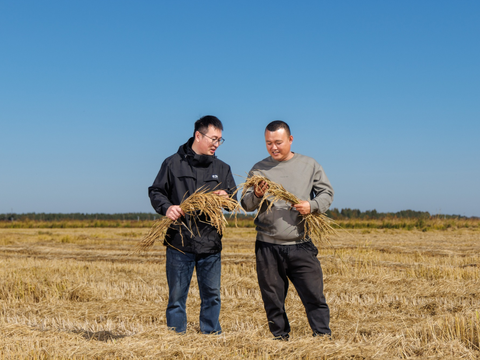
Person examining an uprooted rice plant beside a green rice field while two photographers document the scene.

Japan: from lower methane to benefits across the rice value chain

In Japan, NEWGREEN and BASF are rethinking how rice is grown by combining selected lower-emission rice cultivation practices with xarvio® HEALTHY FIELDS for RiTA, a DSS developed for the project. The collaboration aims to reduce methane emissions and water use while maintaining productivity and creating new opportunities across the rice value chain.
Rows of grapevines in a green vineyard, with a grassy path between them and sunlight filtering through the leaves.

Italy: from vineyard data to lower impact grape production

Across its vineyards in Italy, Leone Alato Group is using Hort@’s DSS and YouSustain to translate field data into more sustainable grape production. Over ten years, the project reduced crop protection use by around 20% on average per year, while recent assessments show GHG emission reductions of 15–25% across most estates, achieved without compromising productivity or grape quality.
Person tending rows of young crops in a cultivated field, with buildings and mountains in the background under a blue sky.

China: from nitrogen efficiency to verified climate impact

In China, Yunnan Yuntianhua and BASF are reducing fertilizer-related emissions through Limus® urease inhibitor technology. In its first three years, the project generated more than 250,000 tonnes of CO₂e emission reductions verified according to ISO 14064, demonstrating what can be achieved through improved nitrogen management.

In our partners’ words

How BASF helps turn insights into actions 

Measurable progress requires more than environmental insights. It depends on connecting measurement, informed decisions, agricultural solutions and farm-level implementation, and then creating the conditions to bring successful approaches to scale. This connected approach helps turn sustainability insights into practical action across agricultural value chains.

Measure

The first step toward decarbonizing the food value chain is creating transparency on environmental impacts. Understanding where GHG emissions occur and which processes drive them helps identify opportunities for improvement while taking productivity into account. AgBalance® and YouSustain are life cycle assessment (LCA) tools that quantify the environmental impacts of crop production, enabling carbon footprint assessments, scenario comparisons and benchmarking.

Decide

Once environmental impacts have been identified, the next step is translating those insights into informed agronomic decisions in the field. Decision support systems such as xarvio® and Hort@ combine weather information, field observations and predictive models to support crop management decisions. They help farmers evaluate risks and optimize crop management, translating complex data into practical guidance that supports productivity, resource efficiency and sustainability outcomes.

Improve

The next step is applying solutions to address specific challenges in the field. BASF’s broader innovation portfolio includes seed and trait technologies, biological and chemical crop protection, nitrogen management solutions and long-standing agronomic expertise. Solutions such as Limus® can help improve nitrogen-use efficiency while supporting productivity, demonstrating how agricultural innovation can contribute to lower-emission farming systems

Our global carbon field trial reports

Global Carbon Field Trial Report 2024 (Edition 1: First Results): Advancing Reliable Climate-Smart Solutions for Farmers & Food Systems

Carbon Field Trial Report 2024 - Edition 1: First Results

See our progress in our journey towards climate-smart agriculture for a more sustainable future.​
PreviewPDF (8.04 MB)
Global Carbon Field Trial Report 2025 (Edition 2: Rice): Advancing Reliable Climate-Smart Solutions for Farmers & Food Systems

Carbon Field Trial Report 2025 - Edition 2: Rice

See our progress in shaping the future of sustainable rice production.
PreviewPDF (8.84 MB)

FAQ

What does decarbonizing agriculture mean?

Decarbonizing agriculture means reducing GHG emissions across crop production and food value chains while continuing to produce the food the world depends on. Because farming systems vary widely by crop, region and climate, there is no one-size-fits-all solution. Progress depends on identifying practical approaches that fit local conditions and can be adopted at scale. At the same time, these solutions must help maintain productivity, strengthen resilience, and create value for farmers and other stakeholders across the food value chain.

Why does it matter for food value chains?

For food companies, reducing emissions increasingly means looking beyond their own operations. A significant share of food-system emissions originates upstream in agricultural production, making agriculture a critical focus for companies pursuing climate targets and Scope 3 reductions. However, transforming agricultural supply chains is complex. Success depends on collaboration across the value chain. Farmers, agricultural suppliers, food manufacturers, retailers, researchers and technology providers each have a role in translating sustainability ambitions into measurable results.

What does successful decarbonization require?

BASF Agricultural Solutions enables agricultural decarbonization through four fundamental principles:

Decarbonizing agriculture starts with trust

BASF Agricultural Solutions is contributing to agricultural decarbonization through a connected approach: Creating transparency on environmental impacts, translating insights into better agronomic decisions and providing innovations that improve agronomic performance.

Productivity and sustainability must go together

Climate-smart agriculture creates lasting value when emissions reductions are achieved while maintaining crop yields, crop quality and farmer viability. For food value chains, environmental  progress and agricultural performance must move together.

Different value chains need different solutions

There is no one-size-fits-all pathway to agricultural decarbonization. Each value chain has its own emissions sources,  agronomic challenges and market requirements. Effective solutions must respond  to these specific conditions while remaining practical and economically viable for farmers.

Proven solutions need partnerships to scale

Many approaches to reduce agricultural emissions already exist. The challenge is implementing them at scale. This requires farmers, food companies, agribusinesses and technology partners working together to turn proven approaches into practical agronomic performance and sustainability benefits.

[1] Crippa, M., Solazzo, E., Guizzardi, D., Monforti-Ferrario, F., Tubiello, F. N. and Leip, A. (2021). Food systems are responsible for a third of global anthropogenic GHG emissions. Nature Food, 2, 198-209. DOI: 10.1038/ s43016-021-00225-9.